
THE PLATFORM
Technology & Byproducts
One controllable reactor platform — tuned for gasification or pyrolysis, sized to your site, and backed by real comparison data. Every run also produces sellable byproducts, biochar chief among them.
THE TECHNOLOGY
One reactor, tuned two ways
Our gasification systems run the same feedstock through a single, controllable thermal process — the difference between a load of biochar and a load of syngas is our patented process control, dialed in before the run starts.
We assess your feedstock and site before we design anything, and verify outputs against permit and offtake specs after the plant runs. In between, here's what “Convert” actually looks like inside the reactor:
Receive & prepare
Incoming waste is shredded and, where needed, baled or dried to a target moisture content before it reaches the reactor. Front-end sorting is a configurable step, not a fixed one — our 440 TPD reference system feeds through a 10-foot-diameter mouth wide enough to accept unsorted waste, recovering metals on the back end instead via magnetic and eddy current separation. Every system is engineered around the customer's existing infrastructure and feedstock, front-end sorted or not.
Thermal conversion
Feedstock moves through the rotary-kiln gasifier under our patented process control — held at the pyrolysis stage to yield biochar, or carried through to full gasification for syngas. Scrap tires run on a separate, dedicated pyrolysis-to-distillation line built specifically for diesel-range fuel recovery, not through the MSW gasifier.
Recover & convert
Syngas fuels combined heat & power; recovered waste heat can pre-dry incoming feedstock in a rotary drum dryer, cutting fuel demand.
Separate outputs
Electricity, biochar, tire-derived diesel and recovered metals and glass are pulled off as distinct, sellable streams.
MSW LINE: GASIFICATION → Syngas → Power
TIRE LINE: Pyrolysis → Distillation → Diesel
PROCESS CONTROL
Same reactor. Different endpoint.
Using our patented process-control technology, the rotary-kiln reactor can be stopped at the pyrolysis stage to maximize biochar, or carried through to full gasification to maximize syngas for power. It's one distinction we've demonstrated in repeated production runs, not just on paper. Scrap-tire feedstock runs on its own dedicated pyrolysis-to-distillation line — see Scrap Tires below for those yields.
MODULAR BY DESIGN
One process, several configurable options at every stage
The reactor's pyrolysis/gasification endpoint is fixed by our patented process control, but almost everything around it is a menu, not a mandate. Intake sorting, gas cleanup, power-generation hardware and grid integration are all selected to fit a specific site's feedstock, permits and interconnection — this reference architecture, drawn from our own engineering documentation, shows the option set at each stage.
BEYOND POWER
Biochar: the byproduct that pays for itself
Every WasteX reactor can be tuned to maximize biochar instead of power — a stable, carbon-rich material with real markets in agriculture, water treatment and construction, on top of the soil-science benefits it's best known for.
Carbon sequestration
Locks carbon in a stable form for hundreds to thousands of years instead of letting it return to the atmosphere as CO2 or methane through decomposition.
Soil fertility & water retention
Its porous structure holds water and nutrients in the root zone, improving yield and drought resilience on degraded or nutrient-poor soils.
Pollution remediation
Adsorbs heavy metals, pesticides and other contaminants in soil and water, a property already in use in low-cost filtration media.
Feed additive & odor control
Used as a livestock feed additive, it can bind toxins and reduce methane from digestion; in manure management it cuts ammonia odor and speeds composting.
Construction material
Can be incorporated into concrete and asphalt to sequester carbon while partially replacing binder, with insulation benefits as a side effect.
Carbon & environmental credits
Qualifying projects can earn carbon-offset revenue for sequestration — on top of, not instead of, the biochar's sale value. Availability depends on registry and jurisdiction.
THE FULL LIST
Biochar benefits by category
The six highlights above are the short version. Click a category to see the complete benefits list we track internally — environmental, agricultural, economic & practical, livestock & husbandry, and other applications.
Carbon Sequestration
Locks carbon in a stable form, mitigating climate change by storing it for hundreds to thousands of years.
Greenhouse Gas Reduction
Reduces methane (CH₄) and nitrous oxide (N₂O) emissions from decomposing waste or agricultural soils.
Waste Management
Converts organic waste into a valuable product, reducing landfill dependency and minimizing open burning and incineration.
Pollution Remediation
Adsorbs heavy metals, pesticides, and other pollutants from soil and water, aiding environmental cleanup.
Reduced Soil Erosion
Improves soil structure and water retention, decreasing surface runoff and protecting against erosion.
Biodiversity Support
Enhances microbial activity in soil, fostering healthier ecosystems for plants and microorganisms.
Soil Fertility Enhancement
Increases nutrient retention (nitrogen, phosphorus and more), making nutrients more available to plants. Has worked very well on the Runion Farm restoring farmland buried under up to 8' of silt and sand by Hurricane Helene.
Water Retention
Porous structure improves soil's capacity to hold water, especially beneficial in drought-prone regions.
pH Regulation
Raises pH of acidic soils, creating better conditions for crop growth and nutrient availability.
Crop Yield Improvement
Boosts agricultural productivity, particularly in degraded or nutrient-poor soils, by improving soil health.
Reduced Fertilizer Use
Retains nutrients longer in the soil, reducing reliance on synthetic fertilizers and associated costs.
Support for Microbial Life
Provides habitat for beneficial microbes that aid in nutrient cycling and plant growth.
Cost Savings for Farmers
Lowers operational costs by reducing fertilizer and irrigation needs over time.
Carbon Credits
Qualifies for carbon offset programs, offering financial incentives for its use in climate mitigation.
Energy Co-Production
Pyrolysis process generates bioenergy (syngas, bio-oil) alongside biochar production.
Long-Term Investment
Provides lasting benefits to soil health and carbon storage for decades or centuries, unlike short-term amendments.
Feed Additive Potential
Reduces methane emissions from livestock digestion and improves animal health by binding toxins in feed.
Odor Control
Decreases ammonia volatilization during manure management, improving air quality around farms.
Compost Enhancement
Speeds up composting while reducing nutrient loss, resulting in higher-quality compost.
Water Filtration
Removes contaminants such as heavy metals and organic pollutants when used in sustainable water filters.
Construction Applications
Can be incorporated into materials like blacktop and concrete to sequester carbon while replacing a portion of the binder, enhancing durability and insulation properties.
Climate Resilience
Improves soil's ability to withstand extreme weather events like droughts or floods, supporting food security.
Historical Precedent
Mimics ancient terra preta soils, which remain fertile centuries later due to biochar-like amendments.
PROVEN, NOT THEORETICAL
Already restoring 100 acres in Tennessee
Our biochar isn't a lab claim — 496.1 tons are already at work on the Runion Family Farm restoration, led by Dr. Forbes Walker of the University of Tennessee Extension, targeting 15–20% higher hay yield and 35–45% less erosion on flood-damaged farmland. See the full results →
WHY W2E, AND HOW BIG IS THIS
How we compare, and the size of the opportunity
Every waste stream we take on raises two questions: why gasification instead of the alternatives, and how many sites are we even talking about. Here's our answer to both, straight from our own comparison research and market-sizing work.
HOW IT COMPARES
Set your own numbers and the three highlighted rows below recompute live. National average tipping fee was about $62/ton in 2024, ranging from roughly $45/ton in the South Central U.S. to $80+/ton in the Northeast (EREF).
Comparative figures are directional, drawn from published industry benchmarks and our own field data — not a substitute for a site-specific engineering study. The three highlighted rows use the same 575 kWh/ton yield and 5–10% residual-to-landfill figures as the System Configurator below, with incineration modeled at half the electricity yield and roughly 80% mass diversion (ash still requires landfilling).
THE ADDRESSABLE MARKET
Thousands of potential sites, across ten distinct segments
Counts below are U.S. and global facility totals from our own market-sizing model — each one a site that generates a waste stream WasteX can take on. Shown on a log scale, since a landfill and a wastewater treatment plant aren't the same order of magnitude.
MODEL YOUR SHARE
If WasteX captured a share of each market, how many sites would that be?
Each segment below is independent — drag any one to set a capture percentage and see how many sites of that segment's total it represents.
Segment totals are U.S. and global facility counts from our own market-sizing model. The sliders above model penetration into a single segment at a time and aren't additive across segments.
EQUIPMENT & MANUFACTURING
We design, build, rent and service the hardware too
Full waste-to-energy plants are one end of what we do. On the other end, we manufacture, rent, lease or sell the individual systems that move and process waste on your site — and stand behind them with our own design and service teams.
Mobile & stationary thermal units
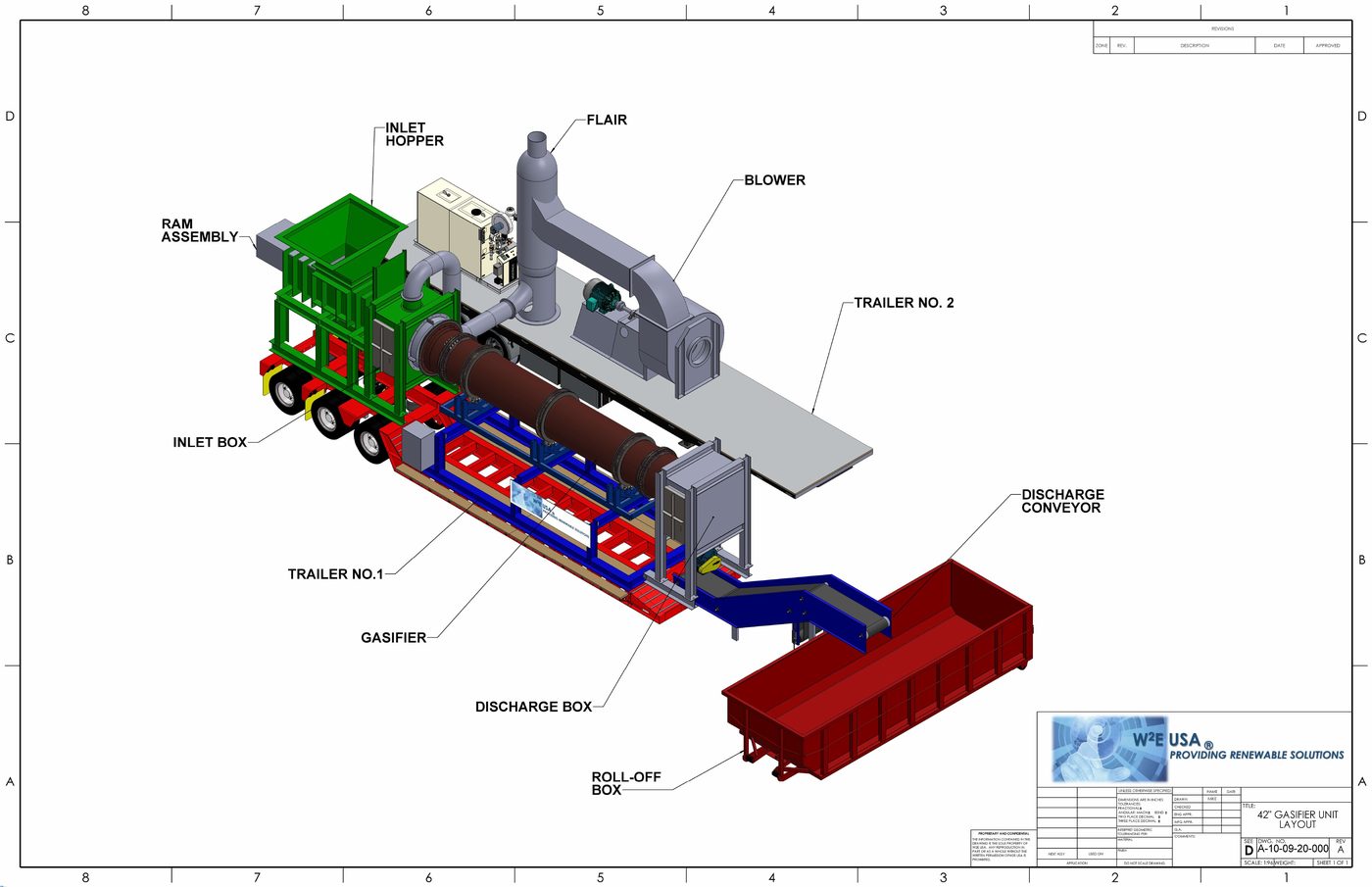
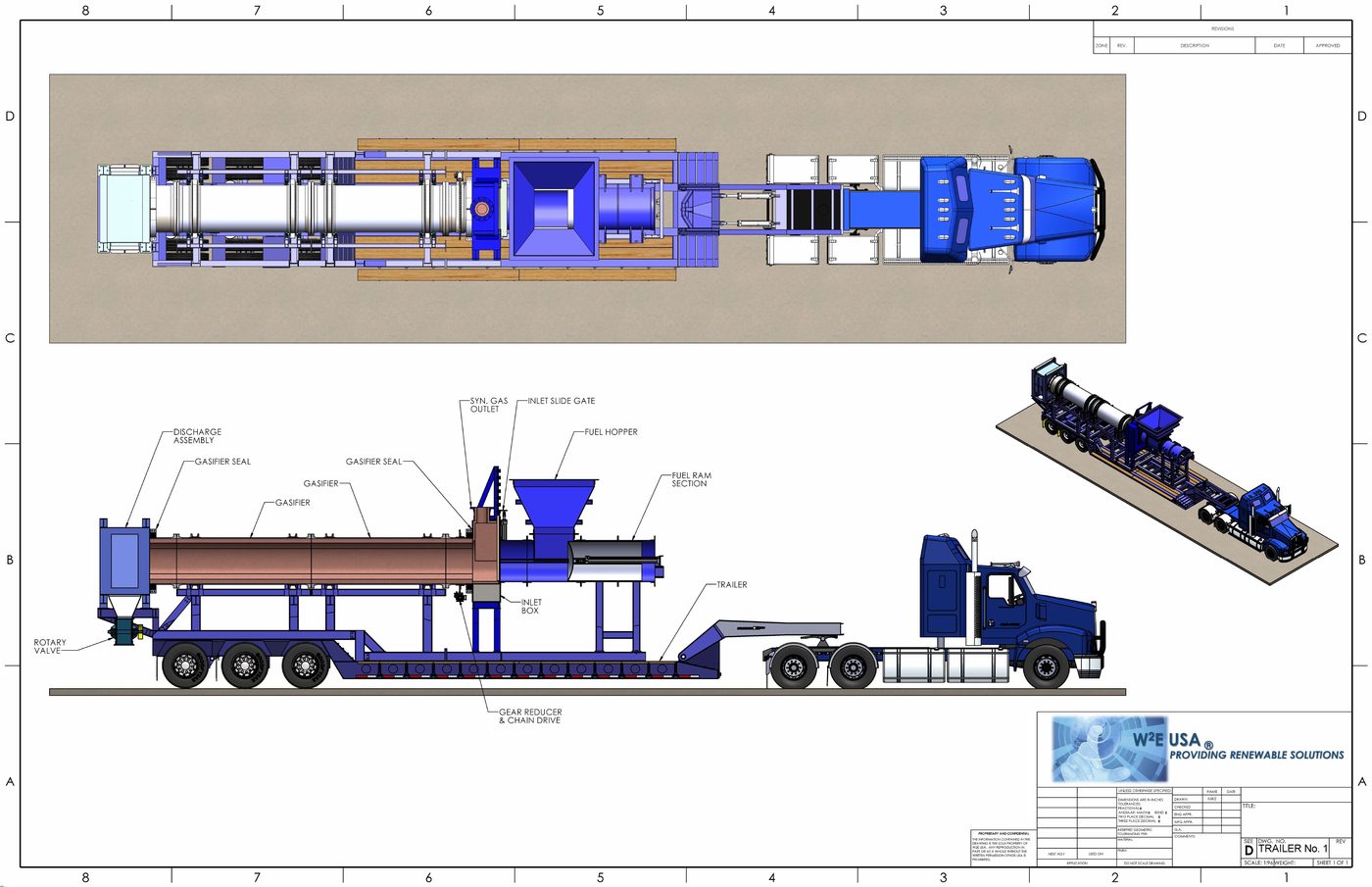
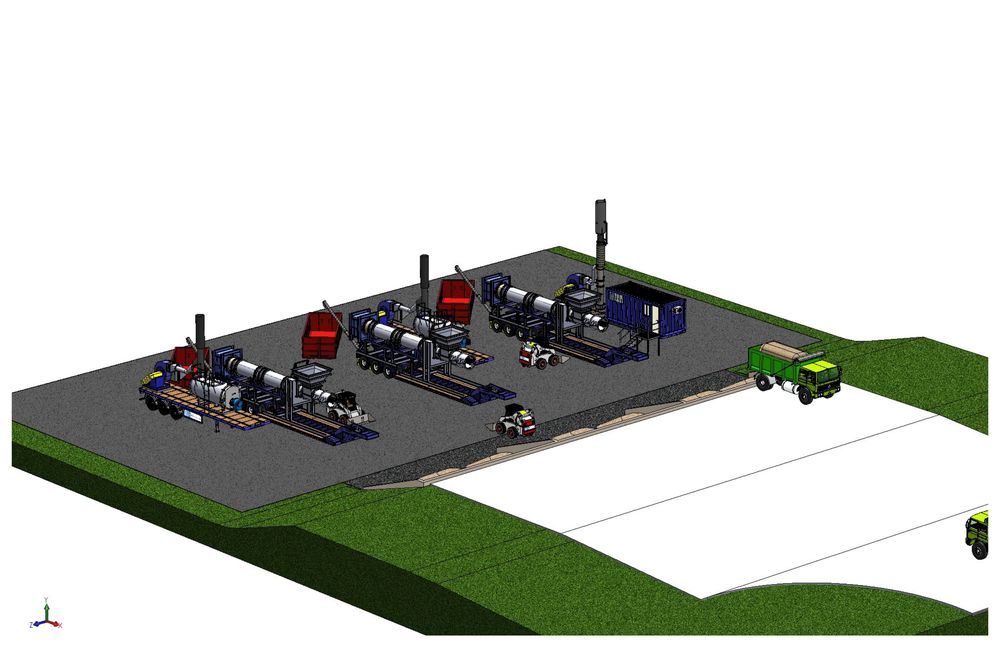
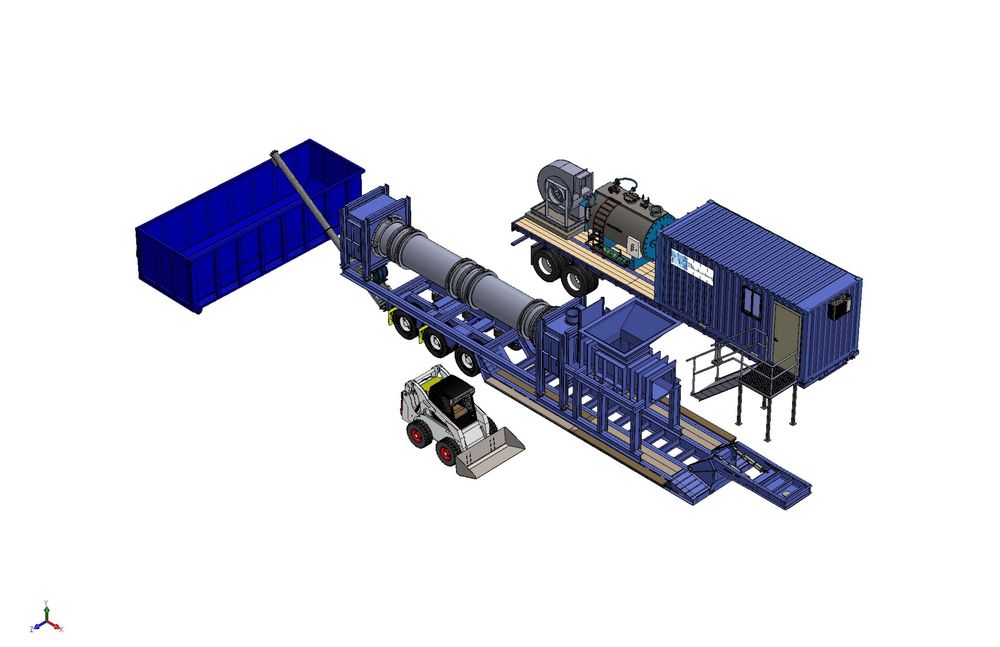
The same rotary-kiln gasification and pyrolysis systems behind our full plants, built as standalone, trailer-mounted or fixed installations sized to a single site.
Size reduction & feedstock prep
Pre-processing equipment that gets mixed waste to a consistent feed size ahead of baling, composting or thermal conversion.
Volume reduction for haul & storage
Densify waste and recyclables for cheaper transport, longer landfill life, or staged feedstock storage ahead of processing.
Thermal & steam systems
Combustion and heat-recovery equipment sized to a site's power and process-heat needs, standalone or paired with our gasification trains.
Material recovery & forming
Processing equipment for turning recovered plastics and other recyclables into a usable, sellable feedstock form.
Built to your site, not off a shelf
Our engineering team designs and fabricates each unit around your feedstock, footprint and permitting — the trailer-mounted system below is one of ours, in the field.
HOW YOU CAN GET IT
Rent it, lease it, own it — or let us run it
Every system above is available as a standalone purchase or built into a full site solution, with the support to match.
APPLICATIONS
Built for the waste stream you actually have
Municipalities, industrial generators, islands and remote sites all show up with different waste — the platform is designed to be reconfigured for the feedstock in front of it, not the other way around.
Municipal solid waste
Diverts everyday household and commercial waste from landfill into power, biochar and recovered metals and glass.
Industrial & refinery waste
Processes refinery residues and other industrial byproducts alongside municipal streams to lift overall plant throughput.
Scrap tires
Our dedicated tire-to-diesel line runs a separate pyrolysis-to-distillation process from our MSW gasifier — at 50 TPD reference scale it yields roughly 6,030 gallons per day of diesel-range fuel (≈121 gal/ton), plus 16.0 tons/day of recovered carbon black and 7.0 tons/day of steel wire, turning a persistent disposal liability into three sellable streams.
Wind-turbine blades
Composite blade material is cut, shredded and gasified — the same char-forming pathway used for woodchips, applied to a growing decommissioning problem.
Biosolids & wastewater
Dewatered sewage and grease-trap (FOG) waste are baled or caked for downstream biochar or compost, integrated with on-site water treatment partners.
Disaster relief & military
Portable, trailer-mounted units bring waste-to-energy capability to remote sites, forward bases and post-disaster deployments. See our disaster relief capabilities →.
FEEDSTOCK DIVERSITY
One platform, a dozen different waste streams
Municipalities, farms, distilleries, hospitals, military bases and island communities all generate waste that mostly ends up in the same place: a landfill. Our platform takes feedstock characterization seriously — sorting, sizing and drying each stream to what the reactor needs — so it can run on whichever of these a given site actually has.
MSW and C&D figures are the EPA's 2018 baseline (its most recently published national totals) scaled ~10% for 2026 using the World Bank's What a Waste 2.0 North America growth trend. Manure is a USDA solid-manure estimate; disaster debris uses FEMA debris-conversion planning factors; sargassum is sourced from the University of South Florida Optical Oceanography Lab's 2025 bloom tracking. The remaining categories are order-of-magnitude industry estimates we are actively sourcing and will update with fully cited figures.
BYPRODUCT PORTFOLIO
What comes out the other end
The same reactor produces different sellable streams depending on feedstock and process control — here's the full portfolio across our systems.
Methane-rich fuel gas
Combusted on-site for combined heat & power, or cleaned for higher-value use. See Technology →.
Grid or microgrid power
Generated from syngas combustion — the core revenue stream modeled into every project. See Market & Comparison →.
Recovered process heat
Waste heat recovery pre-dries incoming feedstock or drives additional power generation, cutting fuel demand.
Extractable from syngas
Where a site's offtake calls for it, hydrogen can be separated from the syngas stream for fuel-cell or industrial use.
Soil amendment & carbon product
Our most developed byproduct — already restoring farmland in Tennessee. See Biochar →.
Carbon-rich solid fuel
A pyrolysis product usable as an industrial fuel or filtration media, depending on feedstock and process endpoint.
Recovered from tire pyrolysis
One of three sellable streams off our dedicated tire-to-diesel line. See Scrap Tires →.
Recovered ferrous & non-ferrous
Pulled off the back end via magnetic and eddy current separation, whether or not incoming waste was sorted first.
Inert recovered aggregate
Separated from mixed waste streams for use as construction aggregate or further glass recycling.
Captured particulate
Collected by emissions control equipment; usable in cement and other construction applications.